Showing posts with label garden. Show all posts

4.15.2012

{Grow} Heirloom Seeds for Sundays


Depending on where you live, the first serious day of gardening season may be Easter, or Memorial Day {or if you're one of the lucky southerners, the season never ended}.

I start most of my garden from seeds, so Easter weekend was prime planting days. I can't think of a more peaceful, spiritual way to start a Sunday than early morning outside with my family in the soil {followed by baths, brunch and church...}. That's exactly where we were last Sunday, and where we're headed now, but not before I leave you with my favorite sources for organic and heirloom seeds so you can spend the next Sunday in your garden.

Most of our garden gets planted with heirloom seeds, since that helps restore the wonderfully diverse food system nature intended. The following are a mix of heirloom and organic seed seed sources. You may not find the same kind of gorgeous, vintage art {pictured} on all of these seed packets, but what's inside is sure to make beautiful, edible art of your yard.


Botanical Interests

Burpee Organic Seeds

Hudson Valley Seed Library

Johnny’s Selected Seeds

Renee’s Garden

Seeds of Change

Seed Savers Exchange

The Cook’s Garden

4.22.2011

{Happy Earth Day!}


{photos by Dasha Wright and Robert Jacobs}


Up north, we wait a long time for garden season, but this year the wait seemed even longer. Last summer, as my belly grew round with the babe, I spent hours and hours tending our small community garden plot, laughing with wonder as the little one inside me kicked and squirmed. When I finally met our giggly girl, Greta, I couldn't wait to take her back there to see our garden with her own blue eyes. 

She was born in November, and the garden sat under a pile of snow for months on end. We'd walk by often during these long winter days, checking for peeks of green, but still the snow fell. 

Finally, five months to the day after Greta was born, we got a rare April day so warm that we headed outside with her hands and feet bare. As she is everywhere in life, she was eager, engaged, reaching out for everything with her curious hands, delighting in the textures and colors of the world around her.  I was thrilled that this place I love seemed just as full as wonder and discovery for her, with more curiosities to offer her than anything she'd seen inside four walls.

We spent that day at the house of our friends Robert and Dasha,  both photographers, who captured Greta's first earth day on film in their own sprawling gardens ~  those first moments as her bare feet touched the soil, her tiny hands reaching for the green shoots of spring onions, and even the I'm pooped mamma tears that ended our garden play-date before I wiped her muddy toes and tucked her into the corner of their plush couch for her afternoon nap. 

It's a rare child who doesn't delight in the texture of warm, damp earth between their toes, the dance of poppies nodding in the wind, and the close attention of their parents sitting side by side with them in the soil.  I wrote about how and why to make your garden a special place for your babes in Mothering Magazine, but in case you missed it, here are my favorite three tips for gardening with a child of any age:

Schedule Garden Time
kids thrive on schedules and predictability.  Schedule a time each day or week to spend in the garden with your child.  Your little one will recognize it as a special bonding time and place where you work as a team to grow healthy foods together.

Build a Food Vocabulary
Babies and young children love the sound of their mother’s voice.  Talk to them while you garden; explain what you are doing and give names to the tools you use and veggies you grow, helping them build their nutrition and food vocabulary season by season.

Designate a Bed In the Garden
No matter how young your little gardener is, pick a patch of soil just for them where the rules and rows of gardening don’t apply. Throw caution to the wind and let your littles dig and experiment at their whim, giving them a sense of independence and pride in what they grow.

There's never been a better time to get started gardening as a family than on Earth Day. You don't need a sprawling garden or any fancy gardening gear, just a few seeds, and a pot, and a little one you love. For more tips on getting started, here's my post on five gardening basics {click here} to grow on. 

Happy Earth Day!

* Special thanks to Robert and Dasha for sharing their little oasis and beautiful photographs with us. *


5.22.2010

5.14.2010

{iced}


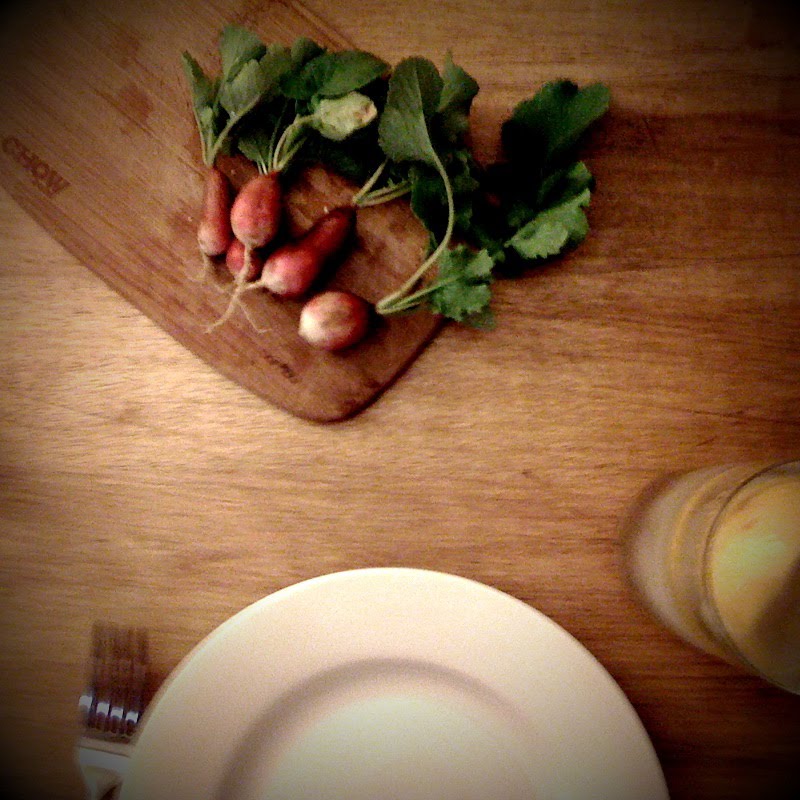
{From the top: Watermelon, Cherry Belle and French Breakfast radishes chill out} 


ny, ny

Everyone knows the best way to eat radishes is raw with good butter and coarse sea salt {I like pasture-raised organic butter and coarse grey salt}. But it also helps to know the best way to prep your radishes after you pull them from the soil.

Radishes love cool weather, which is why we plant them after the first frost and why they're often the first thing to pop up. They're happy to grow into early summer, but a good soak in an ice bath perks up both their roots and their tender tops after they've had a roast in the sun. The same trick works wonders for radishes from the farmer's market who've had all afternoon to wilt in the heat.

When you grow your own radishes, every little bit is usable. Trim the ends, munch on the middle and toss tender green tops into salad, or cook larger leaves with garlic and greens {like turnip and mustard greens}. And, don't forget to plant a new row of seeds every time you pluck a few to keep your crudité platter in plenty.

3.10.2010

It Starts with a Seed {and a pot}


Last night I stayed up till the wees planting over 60 seeds in little newspaper pots that will later become our summer garden. The thing that made it so fun, besides the promise of practically free organic fruits and veggies all summer long, is making rows of little pots with my new paper pot maker.

This paper pot maker came from Jackie Johnson who sells his handmade oak beauties at his store Wood Elements on Etsy. It’s a handy tool; worth it’s cost for the dollars you’ll save on terra cotta since it allows you to roll old newspapers into pots just the right size for seedlings like the tomato starters above. Since the paper will disappear into the soil as the root systems grow, they can be transplanted directly into the ground when the weather warms. 

If you don’t have time or dime to invest, you’ll find a stash of surprisingly suitable pots in your very own kitchen. Save your paper towel tubes and cut them in thirds, and line them up on a sheet tray or baking dish which becomes their temporary bottom when you pack them with soil. 

Once you have your pots, it takes little more than the cost of a bag of potting soil and a few packs of seeds to create your own mini farm. It helps to have somewhere to transplant your farm in about 6 weeks, like a backyard, a set of raised beds or a community garden like mine. But you’ve got plenty of time to sort that out. For now, set the seeds to incubate in the warmest, sun drenched spot in the house where the window light will reach them while you’re away at work. Before you know it, you'll be seeing green. 

It sort of makes the whole growing your own food thing seem easier than you thought huh? Here’s the news—it is. Here are five other things you’ll need to know:

1. Soil
It helps tremendously to start seed in the healthiest soil available. Choose organic “seed starter” or “potting” soil, which is light and loose {those seeds need oxygen}, and designed to have the perfect balance of the nutrients plants need: potassium, phosphorus and nitrogen.

2. Seeds
It has been well argued that organically grown produce has the highest nutrient content. I’m a believer. Start with organic seeds, dated for the current year. Talk to local farmers and gardeners {your farmer’s market is likely full of them} about what grows well in your climate, and where they get their seeds. Some of my favorite online seed sources are: Southern Exposure Seed Exchange, The Seed Savers Exchange, Twin Leaf: Seeds from Thomas Jefferson's Garden at Monticello

3. Light + Warmth
Seeds are dormant storehouses of energy and nutrition, but they need warmth to unlock their potential. That’s why we start seeds indoors in the springtime in cooler climates, where the ground has not yet reached the optimum temperatures. That temperature is different for every plant, but most plants germinate most quickly in soil between 65 and 80 degrees. Seeds don’t need light to germinate, but once they reach the surface they do need about 6 to 8 hours of full daylight.

4. Oxygen
You know this: Plants, like animals, need oxygen, which is why we start tiny seeds in loose soil. Don’t pack your soil too tightly, and water with a light sprinkle or drizzle rather than a heavy douse of water.

5. One Last Tip
Follow the instructions on the seeds for how deep to plant seeds in the soil, but a general rule of thumb is the bigger the seed, the deeper in the soil it should go. Sprinkle tiny lettuce and herb seeds on top of the soil and top with a thin dusting of soil. Press zucchini, cucumber and melon seeds about 1 inch below the soil. They’ll need a deeper root system to grow up big and strong. 

12.24.2009

A Christmas Goose


{Handmade Christmas, part xi}
I can't imagine ever spending Christmas without my family, but one day, we'll spend Christmas in Hungary. When I think of that, I imagine a goose, big and fat, once covered in the white feathers that András grandmother taught me to use to dust flour off her strudel dough. The goose would taste like the one I ate at the Csárdás in Csopak on a cold October night after Andras asked me to be his wife. We {sans A., the Hungarian Vegetarian} would eat it with red cabbage and Olaszirizling and finish the night with Hungarian Rákóczy Cake, and Dios Beigli.
At the Copeland house, Christmas is a perfect repeat of Thanksgiving, Turkey and cranberry relish, mashed potatoes and pecan pie, but whatever the bird, a bundle of herbs from your garden, tied and ready to baste with butter, is the perfect way to whisper thanks to your hostess, and help her fill her bird with flavor.

12.20.2009

Blue Ribbon Beans


{Handmade Christmas, part ix}

Before you put away your sewing machine, here's the perfect thing to put in a little bag made of scrap fabric. Since you were so clever to save your seeds from your summer garden, why not pass them on? Shared seeds are the gift that keep on giving, and keeping heirloom varieties growing in your community is a smart way to protect our seed supply. Plus, every successive season you save seeds, you're more likely grow veggies better suited to your garden's climate than they were the year before.

My favorite thing about seed saving is naming them. Experts like Mike McGrath, host of Public Radio's You Bet Your Garden, claim that if you save the seed of a specific variety for a decade and grow it in the same climate, you earn the right to give it a name. I took that liberty a little early, and am pretty proud to pass on my blue ribbon beans. I can't wait to see them spring up in my neighbor's garden when the snow thaws. Oh, don't forget to add the year of the upcoming season, to remind gardeners to put them in the ground.

P.S. I told you my sewing machine broke, so I cheated. This little satchel game with a gift card from Anthropologie. Recycled giving = green, and in a pinch is as good as handmade!

P.S.S. It's completely covered in white outside!

Spot of Tea


{Handmade Christmas, part viii}
Good morning! I like to start the day with tea. You?
Chances are someone you know does too, and they'd be delighted to get a little hand-sewn satchel of mint or lemon verbena leaves from your very own garden or windowsill. I clipped these bunches from mine just before the snow fell and plan to give them fresh for potent tea, but you can dry them out in a single layer on a lined tray overnight.
This satchel is inspired by The French General, one of my favorite stores for stickers, ribbons, aprons and linens, and the team behind my favorite sewing book, Home Sewn. They sell their signature fabrics here, but if you don't sew, or have a sick machine like me, a paper coffee bag will work just as well.

11.13.2009

The Age of Innocence


l.i.c., new york
Down in Maryland, where I was last Sunday, there were still tomatoes on the vine. Here in New York, the tomatoes are long gone, and with them the golden days that colored them red and warm like the sun. There are a few, here and there, enough to slice over a sandwich, but the last real final harvest happened several weeks ago.
It was a quiet September night, before the clock turned, before our neighbors Hameeda and Fahmeda went back to school and before they moved to the apartment upstairs, where we can no longer count on seeing them waiting for us on the sidewalk when we arrive at home.
Earlier that week, András and I were taking the kayak down the block to Two Coves beach for the last spin of the summer. The 8-foot bright-orange boat must have drawn some attention, because just as we passed their house, Hameeda and both of her brothers flew to the front door. Hearing the commotion, their father came out, followed by Fahmeda who seemed to glide toward us, her pretty head covered with a veil.
The girls ran to me, and I gathered them in my arms.
“What’s this?” I asked, touching the cloth framing Fahmeda's face. “Does this mean you’ve had a birthday?”
Fahmeda is Bengali, and Muslim, and what little I do know about the Muslim faith told me this new cloth marked a coming of age.
“It’s Wednesday,” Fahmeada said.
We three walked together toward the water, Hameeda’s little hand in mine, trailing András, the kyack, the boys and their father down to the water.
The kids and I lapped in the current and waded to our kneecaps while András practiced eskimo rolls. I held Hameeda out of the water when it came too high, and we all soaked in what was sure to be the last sunset of summer.
“So how old will you be?” I asked Fahmeda, picking the conversation back up.
“Eleven.” She said.
“Eleven, that’s a great age!” I said. “Will you have a party?”
“We’ll have a dinner. Upstairs, in the new house.” She said.
Secretly, I hoped to be invited to that birthday dinner. I imagined myself sitting at the table with the children and András, our arms swinging up in down in a prayer before we devoured a table lined with dishes, flavors and spices from Bangledesh. I wondered, if in Bengali custom, it would be impolite to invite myself to dinner.
That night when we came back home, I asked their mother if she thought Fahmeda would like a cake.
“No, no, you don’t need to make something,” her mother said.
“We should cook together,” I said, changing the subject. Fahmeda’s mother is my age, and I fancied us becoming friends, rolling Parothha bread and seasoning vegetable stews with cumin, fennel, fenugreek, and black mustard. “I would like to learn from you. We can go to the garden. We can harvest and bring back vegetables and cook together.”
She laughed, warmly, but as if to change the subject. She has five mouths to feed and likely no time to give lessons.
That Wednesday night, I came home from work to find Fahmeda sticking her head out of the second floor window.
“Happy Birthday!” I called up. “Come down, I have something for you!”
“You remembered!” She tucked her head back in, ran down the stairs to greet me. Hameeda followed.

“Come, let’s go to the garden,” I said, handing her a bushy lemon verbena plant. “I brought you this to plant in honor of your birthday.”
“What is it?” She asked.
“Lemon Verbena. Smell.”
She enhaled. Hameeda imitated her.
“It’s a very lovely herb, for a very lovely girl.”
In the garden, we talked about every vegetable, and snacked on green beans and lettuces. Fahmeda and I dug a deep hole, planted the lemon verbena and patted the soil around it. Then she watered, patiently, suddenly looking more like a woman than a girl, the bright colors of the fabrics surrounding her popping off the graying sky. The sun went down far too fast that night.
Hameeda danced around the garden, touching every plant. She picked all the tomatoes and lined them up in neat rows along the path, then tromped all over them as she watered, making the best of her four-year-old motor skills and splaying water on anything in her path. Fahmeada and I smiled at each other, grown-up girls, enjoying Hameeda’s playful spirit among us.
After dark, I walked the girls to meet their family at the Mosque, despite Fahmeda’s insistence that they’d be okay on their own. I wasn’t ready for her to be that grown up, so she humored me as I guided them the two blocks, then headed home with the crushed tomatoes to make mashed buschetta with aged gouda for András. We drank rose, and toasted to our favorite neighbors, wondering how even when our little shoe box studio gets a little tight, we could ever move away from them.

11.02.2009

Squashing Pumpkins {Sorrel Pesto Recipe}


People seem to give up on pumpkins after Halloween. Not me. While pumpkins don’t always get carved in our home, they do often get baked, split open and seeds removed, drizzled with olive oil, salt and pepper and roasted at 375 until they are soft and squishy {about 1 1/2 hours, depending on the size}.

It’s the grounding nature of pumpkin, its subtly sweet flavor and long lasting energy that has me hooked. But it could also be a subconscious appreciation for the high doses of potassium {known to control blood pressure} and beta-carotene {a cancer-fighting antioxidant} it delivers that seem to reward with a satisfying sensation that few vegetables give all on their own.

But, in truth, it is probably the fact that it comes together as a beautifully healthful dinner in no time when I pair it with homemade sorrel pesto and serve it on a platter along side a glass of good wine.

Pesto, like pumpkin, could be fairly forgettable in the wrong hands. But not in your hands, my friend. Think of pesto as the little black dress of your culinary wardrobe -- Simple, classic, reliable. Give it a few garnishes and you’ve got a stunner on your hands. That’s what’s sorrel does to pesto.

Sorrel is the little engine that could of our garden, growing upward and onward despite weekly clippings, near frosts, and weeks of gloom and gray. It’s somewhere between a green and an herb, too acidic to become a salad, too leafy to waste simply on the occasional chiffonade but brilliant when blended with pine nuts, parmesan, garlic and olive oil, à la pesto.

Sorrel pesto {or any pesto} can be made on the spot, but it’s the perfect thing to make in advance and tuck into the fridge or freezer for a rainy day. And you’ll be glad you did since this modern pesto makes a quick and elegant accoutrement to almost anything from crudités to skirt steak to roasted veggies. Which brings me back to the pumpkin you were roasting while we were talking here. Put it on a lovely platter, drizzle on your fresh pesto, and presto, it’s dinner.


{click recipe to enlarge}

This simple supper came together so effortlessly last Monday night that I forgot to take a picture, inspiring a repeat performance later in the week with acorn squash, a certifiably successful substitute that earned three stars from my most trusted taster.

By the way, you can use the same method to roast pumpkins {or squash} for fresh puree, which is not only the basis for delicious pumpkin breads and pies, but makes a divine little dinner for your lil’ pumpkin too. After roasting, allow pumpkin to cool enough to handle, scrape the flesh from the skin with a fork and put it through a food mill or food processor.
My photo
New York City, United States
Sarah Copeland is a food and lifestyle expert, and the author of Feast: Generous Vegetarian Meals for Any Eater and Every Appetite, and The Newlywed Cookbook. She is the Food Director at Real Simple magazine, and has appeared in numerous national publications including Saveur, Health, Fitness, Shape, Martha Stewart Living and Food & Wine magazines. As a passionate gardener, Sarah's Edible Living philosophy aims to inspire good living through growing, cooking and enjoying delicious, irresistible whole foods. She thrives on homegrown veggies, stinky cheese and chocolate cake. Sarah lives in New York with her husband and their young daughter.