Showing posts with label {grow}. Show all posts

7.31.2012

Golden Zucchini Bread + A Slow Re-Entry into Reality

{photo by Sara Remington}

It's the last day of the endless zucchini feast, and my first day back at my desk after 30 days in planes, trains and automobiles. Although I'm vowing to give up my pastry habit that started on our trip to Hungary, and get back to our grains and vegetable routine, today I'm craving a slow re-entry into reality. I want to stand, glassy-eyed, methodically shredding dewy garden zucchini over a bowl with a box grater,  stirring it with my favorite wooden spoon-- the one I haven't seen in far too long--into a luxe brown-sugar and whole-wheat batter. While the batter ribbons out into my bread tins, I'll think about how in the world to catch this site up on all it missed in Hungary and Helsinki and Chicago, and write the day away to the sweet smell of fresh baking bread...


~

Golden Zucchini Bread

Makes 2 large loaves

{full of goodies} In July, when the garden is bursting with zucchini and the market is practically giving them away, make this slightly sweet bread with just enough veggies to make it good for you. This is divine eaten just a touch warm, with thick slabs of cream cheese spread on for the weekends. Farmer’s cheese or fresh ricotta, both high in protein and much lower in fat, make this a go-to breakfast treat as easy for everyday as it is elegant for breakfast with friends.

4 tbsp/55 g unsalted butter, plus more for the pans, at room temperature
1 cup/200 g lightly packed dark brown sugar
⅔ cup/130 g granulated sugar
3 large eggs
½ cup/120 ml grapeseed or vegetable oil
2 tsp pure vanilla extract
3 cups/400 g white whole-wheat/wholemeal flour
1½ tsp baking soda/bicarbonate of soda
½ tsp baking powder
1 tsp fine sea salt
1 tsp ground cinnamon
1 large zucchini/courgette, grated {about 3 cups/720 ml}
1 firm Bartlett/Williams pear, cored and grated {about 1 cup/240 ml}
¾ cup/85 g chopped toasted walnuts {about 3 oz}, plus more for garnish
¼ cup/40 g golden raisins/sultanas
2 tbsp sesame seeds
½ cup/120 ml farmer’s cheese, ricotta cheese, or cream cheese, for serving
Sliced figs or pears, for serving

Preheat the oven to 350°F/180°C/gas 4. Butter two 9-by-5-in/23-by-12-cm loaf pans/tins. Line them with parchment/baking paper, butter the parchment/baking paper, and set aside.

Beat the butter and sugars in a stand mixer with the paddle attachment, on medium speed until fluffy. Add the eggs, one at a time, beating between each addition. Add the oil and vanilla and stir to combine.

Whisk together the flour, baking soda/bicarbonate of soda, baking powder, salt, and cinnamon in a medium bowl. Mix half the dry ingredients into the butter mixture and stir together. Stir in the remaining dry ingredients with a spatula, along with the zucchini/courgette, pear, nuts, raisins, and sesame seeds.

Divide the batter between the prepared pans. Sprinkle with additional walnuts. Bake until the bread springs back when lightly touched, and a toothpick inserted into the center comes out dry with some crumbs, about 50 minutes. Cool on a rack 10 minutes. Remove from the pan, slice, and serve warm with a thick schmear of cheese and sliced figs.


P.S. Guess what. I finally got it. Two c's, one n. That's Zucchini.


4.22.2012

6 Not Extreme Habits for Eco-Eaters

Writing the Clean and Green Ingredients portion of my new book, which I just finished, was one of the hardest parts to write. That was in part because there is so much controversy and misconception around the idea of eco-eating, not to mention stigma, good or bad, depending on where you come from. I can see my dad's face every time I bring up the topic. I think he believes I'm going to tell him to line dry his paper towels and use them again. Lord knows I'm not. I'm a bit of a hippie, but moderately so. 

I admire folks like Heidi Swanson, author of Super Natural Everyday, and my smart friend Louisa Shafia, who wrote Lucid Food: Cooking for an Eco-Conscious Life, who really broke down food labels like organic and fair trade. I admire Louisa for pushing us to ditch our paper towel habit for good. I'm still working on that one.  

Still, even after 10 years working and training in food, nutrition and sustainable issues, I find all the labels and bylaws of eco-eating can make my head spin. They are important to try to understand, but here's what's most important--DO YOUR BEST. Do your best to eat mindfully, for your health and the health of everyone around you.

My best is committing to this super simple eco-eaters creed, which I hope you'll adopt, too. 

Six Not-Extreme-Habits for Eco-Eating 

  1. Cook. Plastic take-out containers along are enough advertisement for cooking at home most days and nights of the week. It's tastier and healthier, too. 
  2. Shop local. Opt for the food less traveled, which is often cheaper, full of vital nutrients and fresh-picked flavor. 
  3. Buy and cook in season. Commit to eating what nature intended, when nature intended. All foods are the most nutrient-dense and flavorful in season.
  4. BYO-everything. Bring your own wheels (bicycles rock!), your own water bottle, your own market bag, your own lunch to work. Bring your glass milk bottles back and buy olive oil in refillable jugs. Every little bit helps.
  5.  Reduce, Reuse, Recycle. Everything from storing leftover soup in recycled (sterilized) apple sauce jars to turning tin tomato cans into herb planters is a service to every other eater. Find new uses for old things in the kitchen and the garden.
  6. Grow something. Anything. Trees, herbs, vegetables, even a house plant. One grown up tree can provide enough oxygen for a family of four. A 8-Square-Foot garden can provide a great many vegetables for two adults. Herbs grown in a window box save the shipping and storage of cut herbs that might otherwise go bad in your fridge. {Join our 8-Square-Foot Challenge this year!} 
I'm not going to win a Pulitzer prize for this basic list, and for sure, no one is winning one for bringing their recycled canvas lunch sack to work each day, either. But we can all use reminders that our efforts mean something. I hope our best gets us all closer to the point of all the labels and eco-efforts in the first place--cleaner, more delicious, more sustaining ways of eating we can look forward to enjoying again tomorrow. 


4.20.2012

{Earth Day Weekend Project} Plant Raspberries


Last summer, our first in our house upstate, we chanced upon a roadside plant sale with a sign advertising raspberries, $5. Baby Greta had already established herself as a serious raspberry lover, like her daddy, and since it's always been my life-long dream to step outside the backyard into an orchard, or at least a bramble, I was in. I didn't know a thing about planting raspberries, but at $5 a tiny bush {and an old coffee can to leave your cash in}, there was very little risk. Between May and September, Greta and I picked handful upon handful of raspberries off those tiny bushes the grew, in full sun, up to my waist.

This Sunday is Earth Day, the perfect time to put something in the ground that will feed you and your family for years to come. Raspberries need full sun and some trellising, but beyond that, very little from you except water. Plant them as a hedge row, along a fence or any tucked away corner of the yard where they are easy to trellis, and ideally somewhere so close to the kitchen door you can pluck them off the bushes just minutes before you pile them on your weekend waffles or crepes. Spring is the best time to plant raspberries. Before you do, here's what you should know: 

look for.....

Everbearing Raspberries {sometimes called fall-bearing}, which bear fruit slowly but constantly throughout the growing season.  Raspberries come in all sizes and colors from red, purple, golden, or white varieties, so choose your favorite, or plant a bush of each if you have the space. The best sources to buy plants are always your local nursery, where they are likely to sell or at least know what varieties will grow well in your region, but you'll also find them a Home Depot and even some grocery stores, depending on where you live.

raspberries need.....

Raspberries need full sun, plenty of water and light pruning once or twice a year. They grow well in most soils, but prefer sandy loam soil with lots of organic matter {compost and hummus} added to the soil. The key elements are sun, space to grow year by year, and a sturdy trellising system that keeps the canes {branches} off the ground and allows for air to circulate and dry the berries during rainy spells. Plant raspberry bushes or canes in a shallow holes 2 feet apart, with 10 feet between each row. Cover the roots with about 3 inches of soil, not more. Prune each spring by removing tall canes and any weak ones, and prune again the fall after the last {or largest} harvest. 

eat them.....

Raspberries are loaded with fiber, vitamins A, C, folate, antioxidants and minerals. The seeds also contain vitamin E. Eat them whole on top of pancakes, waffles, crepes or ice cream, stirred into muffins or made into pies, cobblers or buckles. They are extremely good eating, and the most healthful, straight from the bush.


4.19.2012

{Grow} The 8 Square Feet Challenge + Garden Tool Giveaway

 {Photo by Dana Gallagher for Whole Living}

What if I told you all the produce in this beautiful plate of pasta was grown in just 8 square feet, in Brooklyn no less?

The recipe for this Vegetable Garden Linguine comes from Whole Living magazine, one of my favorite mags ever. In this issue, they challenged several Brooklyn-based gardeners to grow a feast in just 8 square feet. Not only are the recipes in this story so simply good, the planting strategy attached to each recipe is incredibly practical and easy to execute today. I mean truly, today. You could head to your local nursery directly after reading the article and put your plan into action. It's that simple. 

You have to admit, if we can do it in NYC you really can do it anywhere. With a single raised beds or several pots, just 2 by 4-feet in space, you just might amaze yourself at what you can grow, too. 

I was so inspired by the can-do spirit of this article that this Earth Day, and all summer long, I'm taking the challenge and asking you to do it with me. Leave a comment here to commit to grow at least one homegrown produce-based feast this summer (butter, olive oil, eggs, pasta, cheese, salt, pepper, spices and other pantry staples are free-bees). Check back with me from time to time and tell me how your garden is growing via comments (and leave your names, I want to learn about you!). 

When your feast is complete, send photos of your garden, the meal and your recipe to grow(at)edibleliving(dot)com. The Edible Living team and I will choose a winner based on resourcefulness, creativity, and of course taste. I'll feature the winning recipe and photos right here, with your story. And, to keep your garden growing, I'll send the winner, and the two runners up each one of my favorite gardening tools from Williams-Sonomas' new gardening line, Agrarian, like this gorgeous Joseph Bentley cultivator, below. 


Okay, let the growing begin. Who's In? 

4.15.2012

{Grow} Heirloom Seeds for Sundays


Depending on where you live, the first serious day of gardening season may be Easter, or Memorial Day {or if you're one of the lucky southerners, the season never ended}.

I start most of my garden from seeds, so Easter weekend was prime planting days. I can't think of a more peaceful, spiritual way to start a Sunday than early morning outside with my family in the soil {followed by baths, brunch and church...}. That's exactly where we were last Sunday, and where we're headed now, but not before I leave you with my favorite sources for organic and heirloom seeds so you can spend the next Sunday in your garden.

Most of our garden gets planted with heirloom seeds, since that helps restore the wonderfully diverse food system nature intended. The following are a mix of heirloom and organic seed seed sources. You may not find the same kind of gorgeous, vintage art {pictured} on all of these seed packets, but what's inside is sure to make beautiful, edible art of your yard.


Botanical Interests

Burpee Organic Seeds

Hudson Valley Seed Library

Johnny’s Selected Seeds

Renee’s Garden

Seeds of Change

Seed Savers Exchange

The Cook’s Garden

9.15.2011

Flirting With Fall, But Still Holding Tight to Tomatoes { aka. how to ripen green tomatoes}


With any luck, we'll be eating tomatoes until Thanksgiving. It happens just about every year. We get our plants in late, and survive August on the generosity of our neighboring green-thumbs and the hand-picked treasures of our local farmers. But come September, October and even those first weeks of November, we're in business.

Depending on what climate you live in, September can be peak tomato season. And it's also just cool enough to turn back on your oven or stove. And you know what that means. Yep, BLTS.

It's also the time of the year when the garden gets kind of murky. Plants start to shrivel and suffer from lack of sun,  even with their plump green 'maters still attached. I love nothing more than a sun-ripened tomato that stays on its vine until you pluck it still warm into your hot little hand. But this year's been rough on the garden. Ever since Irene, it's been all about green tomatoes or no tomatoes at all. I let my pale orange-yellow ones ripen to a rosy blush on my windowsill, but if you've got a bunch of greenies, here's a little trick I learned from our neighbor, who at this very moment has 122 of his home-grown  tomatoes ripening on his kitchen table.

1. If your vine is going or the weather threatens of frost, pick tomatoes from them when they are pale green and yellowing, and set aside any rock hard green ones for cooking.  
2. Wrap each tomato in tissue or newspaper and lay them stem side down, where they are their toughest. Keep them in a cool, dark place until they begin to blush. Unwrap and let them finish ripening on the kitchen counter until deep red. 
You won't get quite the same texture as those ripened on the vine in the sun, but they'll beat a grocer's tomato on taste every time. Long live the late-season BLT.

6.16.2011

Hudson Valley Strawberry Picking + A Lesson in Strawberry Propagation

{early bloomers, 'florence' cultivar}


I’ll be the first to admit I still have a lot to learn about gardening. It would help to read up on the truths learned from the gardeners that have gone before me, but it's much more fun (and memorable) to learn as I go, successes and failures alike well-earned.

My first garden trials began around the age of 6. That was the year that the strawberry plants that crept up under the fence from our neighbor's yard stopped producing fruit. It was one of the great tragedies of my childhood.

I had no idea what caused this misfortune to my budding farmstead, but this I knew, we would have strawberries again. One truth guided me: each fruit has a seed from which it came. So, I started collecting the tiny strawberry seeds from our Saturday shortcakes and planting them —  plus whole berries and bitten off caps for good measure—all over the yard. I guess I was never destined to uncover the great mysteries of science. When they never grew, I cut my losses and started planting peach pits instead.

~

Last weekend, when I admired our neighbors Cal and Mary's new hanging strawberry plants, they offered us their runners. I accepted enthusiastically. Though, it dawned on me, I still didn’t really know a lick about propagating strawberries. You don't buy strawberry seeds in the stores like radishes and carrots. I did know that once you have an established plant, growing strawberries is pretty easy. One plant quickly sends out runners and multiplies into three or four, proved by my hearty patch of fragaria vesca (alpine strawberries) in our city plot that started with just two tiny plants several years ago. So creating our own prolific patch from a few runners upstate, I assumed, was easy as easy as strawberry pie. Throw those babies into some soil and poof, fresh berries all summer long. 

Before I had a chance to read up on my latest agricultural theory, Cal brought over 10 leggy runners.
I habitually put herb cuttings from my garden, like basil, and chocolate mint, in big Ball jars of water on the counter until they grow roots, then give them or replant the rooted offspring in the soil to great success. I assumed the strawberry runners would work the same way. They looked healthy and robust, so I tossed them into an enamel tub with water to soak while I did some reading.

Imaging my disappointment when I read (on the BBC Gardening Guide, a trusted source) that to propagate a strawberry plant, you must first plant the runners in a pot or the ground while still attached to the mother plant. Then, when the offspring have hearty roots and new growth, cut them from the mother and transplant.

Oops.

Undeterred, I left the runners in their tub with water over the week while we headed back to the city. When we returned, the runners all had 1/2 to 1-inch roots growing into the water and new, healthy leaves. There's hope for them yet. We planted them in the soil that day, and I promise to report my findings back here (and to the BBC).

Since we won't expect them to fruit until next summer, we were thrilled when G's friend Ruby and her parents invited us to go strawberry picking at Kelder's Farm, part way between our house and theirs.

{josh + ruby, kelder's farm, route 209}

There's plenty of u-pick farms in Duchess and Ulster counties, a perfectly drivable distance from the city for folks who want to taste strawberries straight from the vine. And I highly recommend you do. This four quart bushel below, picked by our budding homesteader (with lots of help from mamma) was mostly gone in a day, piled on top of whole wheat waffles for breakfast, stirred into Greek yogurt with a sprinkling of brown sugar for dessert and eaten up by the handful every hour in between.


{greta, kelder's farm, route 209}


Don't miss out. Go forth, and pick. Here's where: 

Route 209
Kerhonkson, NY 12446
(845) 626-7137
Farm market, U-pick Produce

5100 Rt. 209
Accord, NY 12404
Apple Grower, Roadside Stand, Cider


Oh, and by the way. strawberry plants only produce fruit for about 5 years. If yours stop producing fruit one day, don't go planting peach pits (that doesn't work either). Let those runners run and give new life to your patch.


6.13.2011

you say tomato, i say to-ma-to

{photo by john kernick}

In most parts of the country, there's still time to plant tomatoes. just a little. you could beat the probability of paying three dollars a pound for your summer stash by just a tiny, thin little hair if you put in some seedlings in your soil today. or maybe even tomorrow. need some inspiration? check out this photo of the wonderous world of heirloom tomatoes by photographer john kernick. the full photo accompanies Andrea Reusing's musing on the beloved tomato sandwich in her new book,  Cooking in The Moment, one of this season's very best. 

6.10.2011

confessions of a weed grower

{greta, two coves community garden}

I have a confession to make. My garden is a stage 4 disaster zone. Somewhere between writing this article for Mothering Magazine about gardening with babes, and picking our first radish, Greta outgrew the Moby wrap, started exerting her desire to be on the constant move, adamantly opposing any activity relating to riding against my chest while I pulled weeds. She's riding the fine line between barely sitting and crawling, a girl almost on the move with no time anymore for the sweet sway of my movements lulling her to sleep. 


Earlier, when she was, I eagerly planted rows of strawberries, lettuces and kale, spinach, radishes, and for good measure, a haphazard sprinkling of of Save the Bees flower mix. That was fairly easy, with 5-month-old Greta in her pouch, her arms yet too small and tucked into my chest to cause a wake.


Recently, we were away from the garden for almost two weeks and when we returned and I saw the mess that had become of it, my heart sank. That night Andras saw sadness in my eyes that I couldn't explain. This place of peace and perfection in my former life was now overgrown with weeds. I felt like I was looking upon a home I had built with my own two hands, now abandoned. 

In that moment in the garden, I learned two of life's harder parenting lessons. First, as a mamma, you have less time, which at times makes it imperative to weed out the unnecessary. Maybe its too much to run a business, rebuild a house, cook our meals from scratch and grow our own food in cultivated rows. Maybe instead of growing eight varieties of tomatoes and seven kinds of lettuces, one or two would do.

Second, this is the beginning of me learning to live with imperfection, in the garden and elsewhere. To embrace the chaos, and watch this garden become an environment for Greta's enjoyment and learning, not mine. 

Now that she's sitting and crawling, I can sit curious Greta amongst the wild flowers (indistinguishable from either the edibles or weeds) and let her pull and touch whatever she wishes. It's not perfect, but our girl knows the smell of fresh mint and lavender. She knows the taste of a strawberry we grew ourselves, and of carrot puree made from scratch (even if it took a near-epic excavation to find those carrots beneath it all!)


We won't have a tremendous amount of food from our garden this year. It's is no longer a place of accomplishment, but humility. Of forgiveness. Of letting go. It's a place for a new kind of peace--probably a more lasting one --the peace of excepting life just as it is, and seeing the beauty in every imperfect detail. 


the gardener of invention

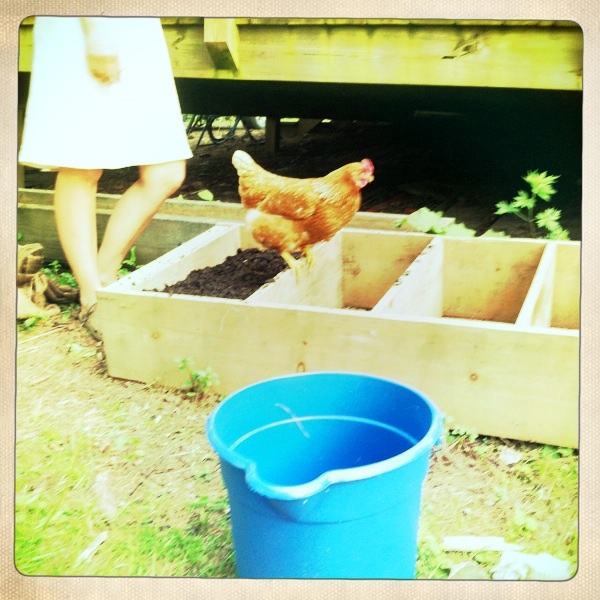
{kristen + pocket the chicken, kerhonkson, ny}


By their very nature, gardeners tend to a resourceful bunch. I love that about them. And urban or rural, if you've got the itch to grow, you'll likely find any place possible to house your seed and soil. Most recycled wood containers—think milk crates, old sand boxes or a bookshelf turned on its side (above)—make pretty good starter raised beds (and chicken playgrounds), and will save you bunches on building costs. With a little creativity, you can grow wide, grow tall, or even grow up a wall (check out Apartment Therapy's great post on vertical gardens). Just grow. Grow any way at all.

4.22.2011

{Happy Earth Day!}


{photos by Dasha Wright and Robert Jacobs}


Up north, we wait a long time for garden season, but this year the wait seemed even longer. Last summer, as my belly grew round with the babe, I spent hours and hours tending our small community garden plot, laughing with wonder as the little one inside me kicked and squirmed. When I finally met our giggly girl, Greta, I couldn't wait to take her back there to see our garden with her own blue eyes. 

She was born in November, and the garden sat under a pile of snow for months on end. We'd walk by often during these long winter days, checking for peeks of green, but still the snow fell. 

Finally, five months to the day after Greta was born, we got a rare April day so warm that we headed outside with her hands and feet bare. As she is everywhere in life, she was eager, engaged, reaching out for everything with her curious hands, delighting in the textures and colors of the world around her.  I was thrilled that this place I love seemed just as full as wonder and discovery for her, with more curiosities to offer her than anything she'd seen inside four walls.

We spent that day at the house of our friends Robert and Dasha,  both photographers, who captured Greta's first earth day on film in their own sprawling gardens ~  those first moments as her bare feet touched the soil, her tiny hands reaching for the green shoots of spring onions, and even the I'm pooped mamma tears that ended our garden play-date before I wiped her muddy toes and tucked her into the corner of their plush couch for her afternoon nap. 

It's a rare child who doesn't delight in the texture of warm, damp earth between their toes, the dance of poppies nodding in the wind, and the close attention of their parents sitting side by side with them in the soil.  I wrote about how and why to make your garden a special place for your babes in Mothering Magazine, but in case you missed it, here are my favorite three tips for gardening with a child of any age:

Schedule Garden Time
kids thrive on schedules and predictability.  Schedule a time each day or week to spend in the garden with your child.  Your little one will recognize it as a special bonding time and place where you work as a team to grow healthy foods together.

Build a Food Vocabulary
Babies and young children love the sound of their mother’s voice.  Talk to them while you garden; explain what you are doing and give names to the tools you use and veggies you grow, helping them build their nutrition and food vocabulary season by season.

Designate a Bed In the Garden
No matter how young your little gardener is, pick a patch of soil just for them where the rules and rows of gardening don’t apply. Throw caution to the wind and let your littles dig and experiment at their whim, giving them a sense of independence and pride in what they grow.

There's never been a better time to get started gardening as a family than on Earth Day. You don't need a sprawling garden or any fancy gardening gear, just a few seeds, and a pot, and a little one you love. For more tips on getting started, here's my post on five gardening basics {click here} to grow on. 

Happy Earth Day!

* Special thanks to Robert and Dasha for sharing their little oasis and beautiful photographs with us. *


2.12.2011

Soil Mates {A Valentine's Day Gift}


Research shows that steady relationships, like lifelong friendships or marriage, are good for our health. And people aren't the only living creatures that benefit from companionship. Many animals mate for life, and even veggies benefit from planting in pairs. Yes, your tomatoes need love too.

Vegetables planted together share health benefits like soil enrichment and natural pest control which translates to more flavor on your plate. Like human love, it's complicated. Enter Soil Mates, a design-savvy garden guide to what to plant together and why. Consider it the match.com for your garden, and the perfect gift for a gardener you love.

9.10.2010

Figs & Joy {In the unlikeliest of places}


l.i.c., ny

Far be it from a Midwestern Methodist to be so bold as to make deals with God. It has always been in my nature to believe He was always there, gently guiding and providing. But a few years ago, when I was reading a book on spirituality by a well-known guru, I was struck that the author wrote that she had a pact with God.  Whenever she doubted something in life, she would ask for a little token to remind her He was there.

Ever since then, whenever I see something growing in an unlikely place, particularly something edible {like a fruiting cherry tree growing stubbornly out of cracked concrete on a city block, or purslane pushing wildly out of a neglected flower bed shaded by towering buildings}, it has become a subtle reminder that out of ugliness can come beauty; a simple lesson of seek and ye shall find.

~

A few weeks ago, when we were shooting my cookbook in Queens, there were a thousand details that needed my care.  Some seemed to require monumental effort, and I wasn’t sure how we would get everything we needed gathered in one place. The day before the 6-days of shooting began, Lillian and Lindsay, my food styling assistant duo extraordinaire, ran to the local Greek market several blocks away on my behalf to pick up the remaining produce for the shoot.

I had all the shots laid out in my mind, and though I thought it was still early for figs in New York, I had a vision of a dreamy bowl of them—the quiet stillness of their tear shape with all the surprise and delight of their glimmering goodness hidden inside.

“I know it’s a long shot, but look for beautiful figs,” I called as they ran out the door.

The two came back an hour later, bubbling over a bag of tiny purple figs, some still dewy as if they had just been picked straight from a tree. They nearly exploded with excitement as they told me how they had found them sitting heaped in a big enamel bowl behind a chain link fence just a few blocks down from me. While they poked about, out came a gentleman farmer who sold them several handfuls of his freshly harvested figs for just two dollars.

I couldn’t believe what I was hearing. Two dollars for bag full of ripe, locally grown figs? I had been prepared to pay a small fortune for them, or for the likely event that the figs they found might have come from Chile, or Morocco. How had I lived in this neighborhood for almost three years and not known I could buy fresh figs right down the block? 

In many ways, the figs became the token reminder during that harried week, that there are beautiful and good things always within our reach, sometimes rather easily. And they turned out to be the star of more than one of my favorite shots in the book {which you’ll have to wait to see}. 

~
After the dust of the shoot settled, I met Lindsay for dinner and a date to hunt down the fig man. He was there, just as they had described, behind a chain link fence with his pot of plump purple and green figs just waiting for the curious.

The curious, in this case {me}, turned out to have many questions. How many figs trees did he have? How long did they take to get that big? Where did he learn to grow them? 

While we talked, I learned that our fig man’s name is Antonio, and that he had planted the three sprawling fig trees in the side yard of his row house over the last ten years. Through the fence, he gave us a little tour of his garden and told us of the hard work it takes to keep it all going.

“I’m 88 1/2 years old, you know,” He volunteered.

“Well, I would have guessed 72!” 

“I wish I knew everything I know now when I was 72!”

~

Antonio came from his home near the border of Italy and Croatia to Astoria many moons ago. I’m so glad he did, for he provided me with figs and joy in the unlikeliest of places, and a divine reminder that sometimes, out of nowhere, our needs are met. If only we are looking.

7.04.2010

gold + rubies, and Sunday sherbet


stonypoint, ny


When a good friend offers to share his gold and rubies with you, you don't refuse. Which is why when our friend Robert gave us the keys to his house for the weekend and carte blanche to pick his golden and ruby red raspberries, we collected them in every spoon, cup, bowl, or basket in site... 


{gold + rubies}


{european red}


{wild}


{golden}


{american red}

I for one am so grateful that the earth's treasures come in so many shape, sizes and colors, each more pleasing than the last. And if ever we tire of the glittering beauties all on their own, I'll spin them into a tart Raspberry Buttermilk Sherbet {click here for recipe}, among the most recent recipes I developed for the Food Network Magazine. A simple sweet that's just right for a Sunday, even the fourth of July. 
My photo
New York City, United States
Sarah Copeland is a food and lifestyle expert, and the author of Feast: Generous Vegetarian Meals for Any Eater and Every Appetite, and The Newlywed Cookbook. She is the Food Director at Real Simple magazine, and has appeared in numerous national publications including Saveur, Health, Fitness, Shape, Martha Stewart Living and Food & Wine magazines. As a passionate gardener, Sarah's Edible Living philosophy aims to inspire good living through growing, cooking and enjoying delicious, irresistible whole foods. She thrives on homegrown veggies, stinky cheese and chocolate cake. Sarah lives in New York with her husband and their young daughter.