8.13.2010

Eat, Pray, Love ~ Date Night with Susan Spungen


This summer, I’ve spent a lot of time thinking on the topic of food and love. If I haven’t already told you, I’m writing my first cookbook, a Newlywed cookbook, for Chronicle Books which has required a lot of eating {and cooking of course}, much praying {since the manuscript is due in three days!!} and unconditional loving {on the part of my husband, who hears nothing but book, book, book!}.  This hasn't left much time for extra writing, or even regular date nights with my beloved. So today we’re having a very exciting date with Susan Spungen, author of recipes, books, and a lot of beautiful food on film, including Eat, Pray, Love which opens in theaters tonight. {hooray!}

If you’re in the food biz, you’ll know her name from her work as the former Editorial Director for food and entertaining at Martha Stewart Living Omnimedia, and if you’re smart you already own her book Recipes: A Collection for the Modern Cook. Movie enthusiast will know her as the food stylist behind the epic food films Julie and Julia, and It’s Complicated

I got a chance to talk with Susan yesterday about these films, and about food, love, and marriage, topics front in center in both of our lives {Susan got married recently too, and is finishing up her next cookbook}. It was such fun hearing about all of stress and thrill of working on the set of each movie, but I have to say the best part was hearing the joy and the generous spirit in her voice when she talked about her husband, and the loving, nurturing act of cooking and eating with the ones we love. 

SC: So, everyone is going to want to know what it was like working on the set of the much anticipated Eat, Pray, Love. I understand that you worked mostly on the scenes that were shot in Italy. Did you use restaurant kitchens to cook and prep the food?

SS: Yes, I spent a few weeks in Italy working on the film. Many of the restaurants were closed for the summer and opened just for our shoot, but all were closed for business while we were shooting. The main chef was usually around to make sure we knew where to find things, but we also had mobile trucks to do some of the prep. 

SC: Italian cooking is famously inspired by the generous, loving cooking of amazing women and mothers, but still restaurant kitchens are relatively dominated by men. Were you nervous about how the chef’s would respond to having you come into their kitchens to work there?

SS: I have to admit I was a little worried, not so much about being a woman, but being an American, about how the chefs would react to me coming into their kitchens. Most of them were very welcoming. But there was one guy that kind of sniffed a little at us being there. We had prepped a rabbit ragu on mobile truck but as you know doesn’t look good cold so we brought it inside to warm it up for the scene. He opened up the Tupperware and kind of gave it a sniff and made a face. But for the most part all of the chefs were very welcoming.

SC: Mmm, rabbit ragu. Just those two words are so evocative. It really sounds like Italy.  I hear there is an outstanding pizza scene set in Naples, where Julia Robert's character says she's having a relationship with her pizza. Can you tell us a little about setting up for this pivotal scene?

SS:  For me that was very fun. I didn’t actually do the food there. The thing about a film is that you never know what you’re walking into. When it was in the early stages of finding out what we’re doing it was assumed we would make the pizza. There were many discussions about if we were making the pizza or if they were making the pizza. Sometimes there’s just one room, and that’s where they are shooting so we can’t prep in there. We tried to to buy portable ovens so that we could cook them in another room, but they turned out to be dinky little microwaves. That’s sort of how it was in Italy, so I thought oh forget it, that will never work. There we were in this amazing place, the most famous pizza place in Naples and therefore the world [L’Antica Pizzeria da Michele] , and it was clear it was best to have the guys do the pizza. They are experts on it, and it cooks in under 60 seconds in their ovens. So what I enjoyed about that was just being behind the scenes at one of the most famous pizzerias in the world, talking to the guys, tasting their pizza.

SC: What an amazing experience. It’s sort of ironic, because that’s what these three movies that you’ve just done are all about, people having these incredible experiences through food where they are just alive, totally enraptured with life.  To this point, The New York Times  called Julie and Julia “a film where what the actors eat is as important as the actors themselves.” I felt like the same was true of It’s Complicated, and I assume that Eat, Pray, Love will be the same. How do you feel about food coming into mainstream films in such a powerful way?

SS: I think it’s great for all of us who love food, and it’s obvious to filmmakers and to Hollywood that it’s become a subset that definitely has a following. There’s a certain segment of the population that can’t get enough, and food has become a form of entertainment. The food can be as much a character in these films.

SC: All three of those movies were essentially love and food stories, where the storyline of each main character’s love of food is as strong, if not stronger, than the story of their love for then men in their lives. After working intimately on all three films, what have you learned about the relationship between love and food?

SS: I’ve always felt that food and love are closely related, especially in a relationship. I have always believed in that stupid cliché, that the best way to a man’s heart is through his stomach. I’ve always believed it and believe me I’ve always used it, and it’s always worked. With the right man anyway. The right man for me is a man who also loves food. I was reading the other day how Francois Payard is marrying a vegan. I thought wow, he must really be in love with her!

SC: I know a little something about that, since my hubby's a vegetarian, well was a strict vegetarian until I cooked seafood for him. But that's another story. So, how and where do you watch the films you’ve worked on? Are you able to enjoy them for their entertainment value and really get lost in the story? Or do you find you are usually critiquing your work?

SS: A little bit of both. The one great thing about movies is that when its all cut together, it’s very different.  Sometimes you are watching for something you know is in there, but then it goes by in a flash or that scene got cut. I think I’ve been able to enjoy all of these films. I’ve been lucky enough to be invited to the premieres of all three, and watch them with a really interested crowd. I just saw Eat, Pray, Love the other night at the premiere. Since I had only worked on Italy portion, a lot of it was completely new for me. But of course I’m also critiquing my work. Usually what I want is more, more, more. I wish the food was on screen longer or shot a little closer. So much work goes into every plate. Eat, Pray, Love was pretty satisfying. The food was photographed beautifully, like the scene with cheese oozing out of the squash blossom. It looked great. During the Italy portions I was really on the edge of my seat, then I kind of settled in and watched the rest of the movie like anyone else. I do get lost in the story for sure. It’s fun to be entertained.

SC: Julia Child called Sole Meunière the most exciting meal of her life. What was yours?

SS: The first thing that comes to mind is our wedding meal. Most people don’t eat at their wedding, but we did. Because our wedding was at Blue Hill at Stone Barns, it was just like a big dinner party. I wanted to eat; I wasn’t going to be one of those brides who didn’t eat at her own wedding. We had the meal in the the dining room, so food was really a big focus, aside from going around and visiting all the tables. And they wouldn’t serve the next course until we were sitting at our table. That was really the most exciting meal. And also my first time at French Laundry would be a close second.

SC: I can agree with both of those. Our wedding was definitely the meal of my lifetime, and both Stone Barns and French Laundry are right up there! 

I read that you actually got to work with Julia child on the book Baking with Julia and the companion show, and I enjoyed your comment that you felt comfortable and happy to pay homage to her in the film Julie and Julia. Between your experience working with Martha Stewart and your work on three epic food films, your culinary prowess is also near legendary, so I don’t picture you as a woman who gets nervous often. Were you nervous to cook for Julia, or do you get nervous cooking for film icons like Meryl?  Is there anyone that you get nervous to cook for?

SS: The funny thing is, in some ways I’m always nervous in that way that if you’re not nervous you’re not paying enough attention. I was nervous about doing Eat, Pray, Love, about finding all the ingredients. Sometimes I can’t sleep but more because I’m worry about the details, making sure I’ve thought everything through, but not about cooking for anyone in specefic. With Julia, I cooked with her but not for her. In fact she cooked for us. I was thinking wow this is incredible, Julia Child is cooking for me. But it was a  perfectly ordinary meal, summer backyard barbeque. She made steak, twice baked potato.

I think sometimes people do get too nervous about cooking and they should just focus on the idea that they are doing something they enjoy. I don’t think you should get nervous to cook for anyone. Even Thomas Keller. I would not be afraid to have Thomas Keller over for dinner. I would cook him something simple and I’m sure he would love it. Cooking is about giving something to someone, not about being perfect. Anyone can enjoy being cooked for.  I love cooking for chef friends, and they love having someone else cook for them.  And then when they compliment your cooking, what could be better than that?

SC: You’re so right, and that’s a beautiful philosophy. Speaking of getting nervous, I absolutely loved the scene in it’s complicated where Meryl Streep makes chocolate croissants in the middle of the night for Steve Martin. I couldn’t help thinking that she’s such a natural. Do you think that’s because she had already done Julie and Julia, or did you coach her?

SS: She discounts it but I think she has a certain comfort level with food. Plus, she’s Meryl Streep, so she’s just really, really amazing at picking things up quickly. Part of her unbelieveable talent that she can just pick something up and look completely natural at it. In Julie and Julia I gave her a ten minute lesson on how to flip an omelet, and she just went in and did it on film. Those scenes [in It’s Complicated] working with the croissant dough we did that at Sarabeth’s bakery in Chelsea [Chelsea Market]. We were coaching her a little but mostly she just got it.

SC: My hubby and I saw a ten o’clock showing of that movie, and when we came home, we both couldn’t stop craving croissants so I started making a batch at midnight. I was thinking I would just do a few folds of the dough and go to bed and finish them in the morning. I had forgotten how long it really takes, and I was so tired I forgot the yeast. When I woke up in the morning and got to the part that said proof, I realized I had actually made puff pastry! It was delicious puff pastry, but….somehow I still sort of love how that scene sort of gives this illusion that this grand gesture was really quite simple. What’s the most generous, loving cooking you’ve ever done for your hubby?

SS: I don’t know if I’ve ever done anything quite as dramatic as that. That’s Hollywood, and as we know you could never make that as quickly in real life. Of course Nancy Meyers, the director, knew that too. Sarabeth kept saying there must be time for proofing and Nancy would say, “Don’t worry about the recipe, this is not a cooking show!” It’s a movie. Honestly, that’s more performance driven, but in terms of making something loving for my husband? I make him chicken soup when he’s sick. He’ll ask me, “can you make some soup?” You know how men are when they are sick, sort of sad and pathetic.

SC: Yes, I do!

SS: I’ve cooked for him so much. I feel like every meal I cook for him is a very caring act.

SC: I was sort of hoping you’d say something like that. I feel like going all out in the kitchen is the cook’s equivalent of putting on a really sexy dress. But we can’t do that every night. After working on three films on food and love, and a few years of marriage, what advice do you have for newlyweds?

SS: I don’t think it’s about impressing them, especially after your married. It’s more about comfort. That’s a first date thing, impressing—I think I made him a Valentine’s meal where I was trying to do that, but I wouldn’t cook for him that way now. That was more of a seduction kind of meal.

SC: Well it worked! So, how do you know when your husband really loves something you’ve made for him?

SS: He’s really appreciative usually. I don’t know if I can say what he does because when he really likes something he makes these noises and I think, Oh he’s making sex noises. Is that too risqué?
  

SC: No, I think it’s great! My hubby is really intent about eating. He just dives in very quietly and sometimes when he’s done I have to ask, so, did you like it? The answer is usually a resounding yes but that was hard for me to get used to because my dad has always been a very vocal eater. He would always say “oh honey, honey, this is de-licious!” when we really liked something.

SS: Yes, the noises are good. But sometimes when they are very quiet it’s because they are really enjoying something and focused on it.

SC: So does he ever cook for you, your husband?

SS: He does. He is a different kind of cook than me. He’s very resourceful, and has made me be more resourceful with leftovers. He’s really good at cleaning out the fridge, and so I’ve gotten a little bit better at what we call scrounging. He’s so good at putting it together. I always think we need to go buy something, or what’s left in the fridge is too old. So I’ve gotten more accepting. And sometimes he gets a little too nervous in the kitchen. If he’s cooking I can’t even go in the kitchen, if I say anything or do anything. He loves to make barbecue on the Big Green Egg.

SC: That sounds like a man toy.

SS: Exactly. It’s a ceramic grill, like a Japanese Kamado oven. It’s good for smoking.

SC: So, I loved your first book. It’s very smart, and really teaches people how to cook. What’s next for you? Can you tell us about your new book?

SS: My next book is not just recipes, it includes a lot of tips and how-tos for every aspect of entertaining. It’s geared to younger hostess who might not have learned these things from their mother, sort of etiquette for the new millennium.

SC: It sounds like it needs to be on my list of 5 books every newlywed needs.

SS: Yes, but not yet! It’s not out until 2011.

SC: I’ll look forward to it. My book is not out until 2012 and that feels like a very long time away. Just one last question, Eat, Pray, Love is as much about an appetite for life as anything else. How do you keep your appetite for life? 

SS: One word pops into my head and that’s curiosity. You have to remain curious about everything in your life and your cooking; you have to constantly expand your horizons in many ways. We’re only here for a short time. My father just passed away recently and it just made me think a lot about what life is all about. He had a real appetite for life. He just liked to have fun and explore new things and travel and go places. He was constantly in the quest for fun and excitement and I’ve taken that from him. I like to learn. Even going to Rome to do Eat, Pray, Love was about that. I couldn’t pass up that opportunity. I knew it would be nerve-wracking but I still wanted the experience and I did learn so much about life and myself. You can be in a place like Rome it all sounds so exciting but you can feel a little lonely in a foreign city by yourself. My husband came over right in the middle and was just so happy to see him.

~ Spoken like a newlywed. 

7.04.2010

gold + rubies, and Sunday sherbet


stonypoint, ny


When a good friend offers to share his gold and rubies with you, you don't refuse. Which is why when our friend Robert gave us the keys to his house for the weekend and carte blanche to pick his golden and ruby red raspberries, we collected them in every spoon, cup, bowl, or basket in site... 


{gold + rubies}


{european red}


{wild}


{golden}


{american red}

I for one am so grateful that the earth's treasures come in so many shape, sizes and colors, each more pleasing than the last. And if ever we tire of the glittering beauties all on their own, I'll spin them into a tart Raspberry Buttermilk Sherbet {click here for recipe}, among the most recent recipes I developed for the Food Network Magazine. A simple sweet that's just right for a Sunday, even the fourth of July. 

7.02.2010

Life, Liberty and the Pursuit of Grilled Cheese


~ We hold these truths to be self-evident, that all men are created equal, 
that they are endowed by their Creator with certain unalienable Rights, that among these are 
Life, Liberty and the pursuit of Happiness. ~

u.s.a.

One Thursday in May, in a courthouse in Brooklyn, 240 people became American citizens. One of them was my husband András. He is among the one hundred million Americans that have become citizens by oath rather than birth since our nation began over 230 years ago

The story of András’ citizenship is not mine to tell. Most of it happened before I even knew him—the green card application process, the steep fees, the long waiting, lawyers, courts, exams, and the 5 long years where he could not travel home to see his family. By the time we met, András was a green-card carrying permanent resident who knew more about our country than I did. He studied and revered our founding fathers; he knew the names and spellings of most members of congress. 

I was only there to cheer him toward the finish line, to quiz him in preparation for his final citizenship exam, to pick out his tie for his last interview, and stand by him with an un-earned pride in his journey as he stood taking his Oath of Allegiance. I even cried a little. Then, we covered our hearts with our hands and spoke the Pledge of Allegiance to a flag and the liberty it stands for that I’d long since taken for granted.

When it was over, the judge addressed the audience.

“This oath signifies your confidence in the United States of America,” she said.

I hadn’t spent much time thinking about my own confidence in this nation, but this was a concept that András, who was born into an era of communism in Hungary, understood very well. It’s confidence that the nation will defend its borders, that no government including our own can come in and steel your land or your liberty. It means that you can travel freely beyond our borders and come home again any time you wish.

Unconsciously, I believe my confidence in this land is in its people, the diversity of our origins and the opportunities and tolerance that breeds. My confidence is in self-made men, like András, who continue to build the nation with their own two hands and who hold fast to the rights of life, liberty and the pursuit of happiness.

Our own pursuit of happiness began with hamburgers {veggie for him, beef for me} and fries at Williamsburger directly following his naturalization. András took a hold of two catsup containers and assaulted his plate like only a true American could. I was proud.

It continued on as we celebrated for two weeks, with friends in New York and with my parents in Illinois over meal upon meal deeply rooted in American tradition. We had corndogs and watermelon and potato salad on endless stacks of star-spangled plates from Costo. We drank bottles of coca-cola and attacked mom's chocolate chip cookies and homemade chocolate cake. We ate grilled cheese and bad pie in a half dozen diners from San Francisco to New York and we loved every minute of it.

Though he has a deep love and reverence for his homeland, András was made to be an American. He loves tuna melts and potato chips, skateboards and baseball caps and can hover down a handful of M&Ms with the best of them. He pledges allegiance to Pearl Jam and Metallica and this morning he even woke up humming the national anthem. But still, after deep indoctrination into the fabric of this great nation, I felt something was missing, until last weekend, when András cooked his first meal on his very own American-made gas grill, my gift to honor his achievement.

This weekend we will celebrate our independence quietly, in a little house in the country where András can rock out on the grill and I can put my feet up, drink lemonade and give thanks for his confidence in the United States of America. 

6.30.2010

To Market, for Sour Cherries


In many parts of the country today is a market day. Except in my little corner of the world where the market just 40 yards from my front door doesn’t open until July. Instead of lamenting the fact that my borough is a beat behind, I’m digging into the tastes and textures of the world markets featured in the latest issue of Saveur , which pays tribute to this season’s produce all around the globe.

The issue also features my article about the plump, glimmering sour cherries that pop up this time of the year all over Hungary, and in the Veszprem farmer’s market where we shop when we visit. And it’s perfect timing, since tomorrow is the first day of July which means cherries –sweet, golden, ruby red or sour— will likely be popping up in you’re your corner of the world too.


{Anya's Sour Cherry Cake, click here for the recipe

András mother, whom we call Anya {mother}, turns her sour cherries into a simple toothsome sponge cake she calls kevert meggyesem {my mixed sour cherries} made with graham flour, the perfect compliment to your cherry of choice. Saveur also published her recipe, so now it can be yours too. 


6.26.2010

{Mulberries}...So Early in the Morning


Call me naïve, but I rarely doubt a nursery rhyme. Which is why it wasn’t till I reached the ripe age of 29 that I discovered that mulberries don’t actually grow on bushes.

On the contrary, mulberries grow on trees so tall that the lowest of their branches often tower just about my reach on tippy toes. I discovered this when András and I found a mulberry tree at the edge of the park blocks just two blocks from our home.

In pursuit of collecting the thousands of tiny berries before they fall to their squishy death, I’ve implored András to carry a step ladder the to the park with me for late-night pickings, encouraged nimble friends to climb its branches and sometimes even just waited, patiently, for them to drop right into my hands. But we rarely take home more than a pint or two.

After two years of meager harvests, András recently let me in on a little secret. In the old country, folks unfold a large old sheet under their mulberry tree and employ a little rascal to climb up in the branches and shake them until all the ripe berries fall to the sheet. They gather the edges and carry their loot home for preserves or pies.

Having neither an old sheet nor a little rascal, and a mulberry tree past its peak, I thought I’d have to wait until next year to put that plan into play.  Until yesterday, when my friend Jenny pointed out that there were several more enormous trees, branches heavy with purple or white berries, lining the path that adjoined our two parks where I often take an evening walk or run. That’s what happens when you’re too busy marching forward to stop and look up ~ you just might miss something incredibly delicious.


People always ask me how I eat these foraged mulberries. I’ve twice collected enough to make mulberry lemonade popsicles, and recently picked enough during a bike ride into the woods with my Dad in Illinois to turn into mulberry shortcakes, which were both superb. They are also excellent on premium vanilla-bean ice cream. But the truth is they are best of all eaten out of hand straight from the tree, or the bush, if that’s where your mulberries grow.

5.22.2010

5.14.2010

{iced}


{From the top: Watermelon, Cherry Belle and French Breakfast radishes chill out} 


ny, ny

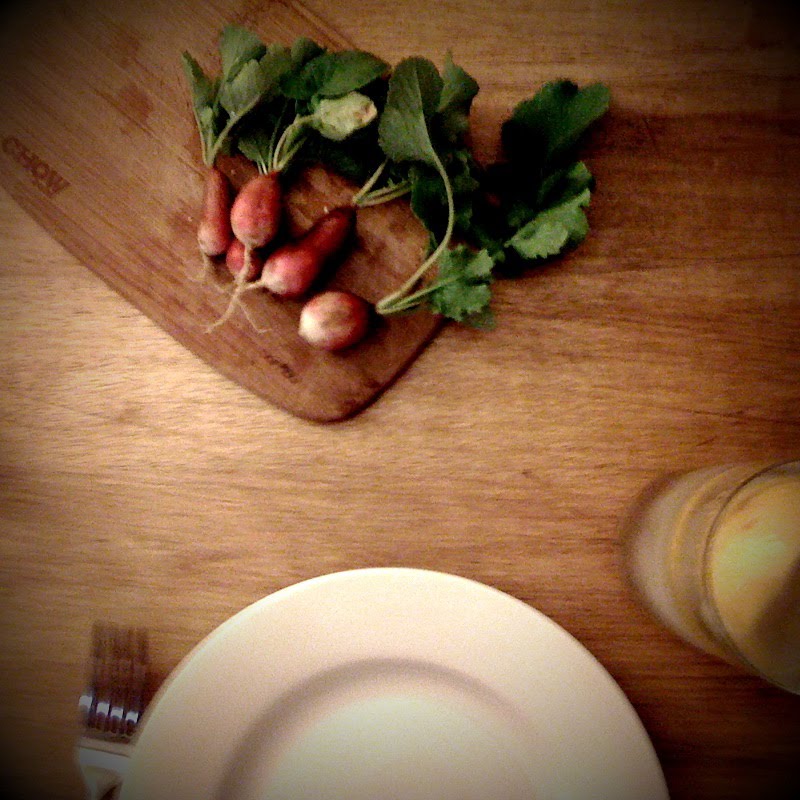
Everyone knows the best way to eat radishes is raw with good butter and coarse sea salt {I like pasture-raised organic butter and coarse grey salt}. But it also helps to know the best way to prep your radishes after you pull them from the soil.

Radishes love cool weather, which is why we plant them after the first frost and why they're often the first thing to pop up. They're happy to grow into early summer, but a good soak in an ice bath perks up both their roots and their tender tops after they've had a roast in the sun. The same trick works wonders for radishes from the farmer's market who've had all afternoon to wilt in the heat.

When you grow your own radishes, every little bit is usable. Trim the ends, munch on the middle and toss tender green tops into salad, or cook larger leaves with garlic and greens {like turnip and mustard greens}. And, don't forget to plant a new row of seeds every time you pluck a few to keep your crudité platter in plenty.

4.17.2010

Pedaling Gastronome

So, what’s with the bike?

The bike stands equally for playfulness and progress. We couldn’t have gotten very far without the wheel, and my, oh my the places we can go now that we have them! Progress sometimes means looking backward to what used to work and reviving the things we hold dear {thus, the vintage bike} like homegrown and handmade and putting a good old fashioned meal on the table.

As for playfulness, who doesn’t feel carefree and childlike when riding a bike? If you don’t, close your eyes, imagine you’ve just eaten a crepe and you’re now pedaling along the tree-lined sidewalk on the Champs-Élysées. That is part of the philosophy behind Edible Living—inspiring the urge to pack up a picnic, hop on the bike and roll through the day.

My bike basket, or musette bag {side bag} is usually full of goodies. I’ll help make sure yours is too. And yes, you’re on to me—my dear husband is a cyclist, so the bike is a nod to him too. 


What about the shovel?

I’m a gardener, but the shovel represents so much more than just digging in the dirt. When I graduated from journalism school, my professor gave me a garden shovel with a note that said “keep digging.” I have never stopped. The shovel represents curiosity, and the spirit of digging into life to find what you love, always being willing to dig a little deeper to cultivate the joy and goodness you’re looking for.

Now it’s your turn. What does Edible Living mean to you? 

4.10.2010

Eat Cake, and Vegetables!


It's official, Edible Living is now a published trademark, news that comes with very good timing. After 6 wonderful years at the Food Network, I'm making a leap out of that cozy and very delicious nest to start my own business. With that, comes a lot of questions, like what, exactly, is Edible Living? 

Edible Living is a lifestyle and a philosophy. It is discovering joy in the places and moments where food intersects life, and embracing the stories that fuel our curiosity and delight.


Edible Living is...


         ...full bellies and full lives 

               ...good health and good cheer

         ...discovery and delight


             ...community and sustainability


It's about having your cake, and your vegetables too. 

Most of all, Edible Living is a conversation that I hope you find engaging and inspiring. Please join in, I would love to hear from you! 

3.20.2010

Urban Gardening {Morning Glory}


Happy first day of Spring! To help you get outside and cultivate your green thumb, I'll show you how to get growing the cheap and easy way by turning kitchen tools into garden tools on Danny Boome's new morning show, Morning Glory.

3.10.2010

It Starts with a Seed {and a pot}


Last night I stayed up till the wees planting over 60 seeds in little newspaper pots that will later become our summer garden. The thing that made it so fun, besides the promise of practically free organic fruits and veggies all summer long, is making rows of little pots with my new paper pot maker.

This paper pot maker came from Jackie Johnson who sells his handmade oak beauties at his store Wood Elements on Etsy. It’s a handy tool; worth it’s cost for the dollars you’ll save on terra cotta since it allows you to roll old newspapers into pots just the right size for seedlings like the tomato starters above. Since the paper will disappear into the soil as the root systems grow, they can be transplanted directly into the ground when the weather warms. 

If you don’t have time or dime to invest, you’ll find a stash of surprisingly suitable pots in your very own kitchen. Save your paper towel tubes and cut them in thirds, and line them up on a sheet tray or baking dish which becomes their temporary bottom when you pack them with soil. 

Once you have your pots, it takes little more than the cost of a bag of potting soil and a few packs of seeds to create your own mini farm. It helps to have somewhere to transplant your farm in about 6 weeks, like a backyard, a set of raised beds or a community garden like mine. But you’ve got plenty of time to sort that out. For now, set the seeds to incubate in the warmest, sun drenched spot in the house where the window light will reach them while you’re away at work. Before you know it, you'll be seeing green. 

It sort of makes the whole growing your own food thing seem easier than you thought huh? Here’s the news—it is. Here are five other things you’ll need to know:

1. Soil
It helps tremendously to start seed in the healthiest soil available. Choose organic “seed starter” or “potting” soil, which is light and loose {those seeds need oxygen}, and designed to have the perfect balance of the nutrients plants need: potassium, phosphorus and nitrogen.

2. Seeds
It has been well argued that organically grown produce has the highest nutrient content. I’m a believer. Start with organic seeds, dated for the current year. Talk to local farmers and gardeners {your farmer’s market is likely full of them} about what grows well in your climate, and where they get their seeds. Some of my favorite online seed sources are: Southern Exposure Seed Exchange, The Seed Savers Exchange, Twin Leaf: Seeds from Thomas Jefferson's Garden at Monticello

3. Light + Warmth
Seeds are dormant storehouses of energy and nutrition, but they need warmth to unlock their potential. That’s why we start seeds indoors in the springtime in cooler climates, where the ground has not yet reached the optimum temperatures. That temperature is different for every plant, but most plants germinate most quickly in soil between 65 and 80 degrees. Seeds don’t need light to germinate, but once they reach the surface they do need about 6 to 8 hours of full daylight.

4. Oxygen
You know this: Plants, like animals, need oxygen, which is why we start tiny seeds in loose soil. Don’t pack your soil too tightly, and water with a light sprinkle or drizzle rather than a heavy douse of water.

5. One Last Tip
Follow the instructions on the seeds for how deep to plant seeds in the soil, but a general rule of thumb is the bigger the seed, the deeper in the soil it should go. Sprinkle tiny lettuce and herb seeds on top of the soil and top with a thin dusting of soil. Press zucchini, cucumber and melon seeds about 1 inch below the soil. They’ll need a deeper root system to grow up big and strong. 

3.09.2010

Indulge Yourself, Darling! {pudding}

l.i.c., ny 

Last night I came home, opened the fridge, and found this…


…which was meant to be dessert for tonight’s dinner. Why thank you, I guess you like my chocolate pudding! 

Here is my recipe, and the rest of the meal that goes with it—a most satisfying savory cheese and potato pie with a layer of ham that you really must make {really, I insist, it’s one of my most delicious creations!}. I developed these recipes for the March issue of the Food Network Magazine that is about to disappear from the newsstands to make way for May. But don't worry, these recipes are yours to keep, so there's plenty of time for pie and pudding making.


3.06.2010

A Movable Feast {join us!}


new york, new york

This morning at 6 am, András and hundreds of other road racers pedaled 30 miles around New York’s Central Park in the first race of the cycling season. When he came home and found me still snug in bed, his first question of course, was “what’s for breakfast.”

For three cycling seasons running, I’ve held the role of #1 fan and feeder-in-chief, which translates to VIP to a man who burns around 1,800 calories on a breezy Saturday morning. Since feeding the ones I love feeds my soul, I gladly accept. But as often as food is fuel for his next ride, the pursuit of good food also fuels our passion for hopping on the bikes together and finding our next feast. That’s why were such big fans of the new cycling travel series dedicated to regional foods, called Pedaling.

The series, which documents the movable feasts of competitive cyclists and commuters, makes stops in some of my favorite city stomping grounds and gives anyone who watches good reason to get out an explore their own city on a bike. 

If you happen to live in my city, New York, I’ve dreamed up two classes at Whole Foods Bowery Culinary Center that celebrate food + bicycles, and the launch of Pedaling TV. If you like to eat and ride, or love someone who does, join us: 


Thursday, March 18
A Movable Feast
6 pm to 9 pm

Calling all biking and baking enthusiasts! Come gear up for your own season of pedaling with culinary expert and Pedaling enthusiast Sarah Copeland; tonight's class is devoted to the making of classic doughs  that provide a flavor foundation for high-quality, high-energy fuel for your next cycling adventure. Learn to make homemade sourdough and whole wheat pizza doughs, and versatile pie dough that swings sweet and savory. 

On the Menu: 
Whole-Wheat Flatbread with Fresh Ricotta; Fingerling-Potato Pizza; Mashed Potato + Meat Pies; Little Breakfast Pies with Seasonal Fruit; Musette Pies. 


Thursday, April 29
Food As Fuel: Energy for Biking & Beyond
6 pm to 9 pm

Whether you're getting ready for the Five Boro Bike Tour, your daily commute or weekend ride through the country, pedaling requires high quality endurance foods that are high-energy, low-fat and low-maintenance. Join culinary expert and pedaling enthusiast Sarah Copeland as she unlocks the secret of "food fuel" that's as delicious as it is nutritious. Come prepare an endurance feast to fuel up for your next two-wheeled journey during tonight's family style dinner party. 

On the Menu: 
Hand-made whole-grain soft pretzels, Baja Fish Tacos with Homemade Corn Tortillas, Smashed Plantains with Cotija Cheese and Lime; Horchata Rice Pudding. 


3.03.2010

House of Bread


“Everybody needs beauty as well as bread “~ John Muir


lic, ny

A few years ago, I moved from Manhattan to Queens to be with András, kicking and screaming the whole way. I had lived in Manhattan for 9 years, was convinced that my favorite things would be too far out of reach in his borough. He lured me with love, a farmer’s market right outside our building and promises of good bread.

The farmer’s market is indeed a gem, but the bread he spoke of came from an old Greek bakery below our subway stop and was wholly unremarkable. Luckily for him though, he was right, Queens is home to some of the best bakers in town. 

On a summer bike ride around the neighborhood, I passed a truck that said Pain D’Avignon, and followed it home down the street in hopes of finding French bakers that recalled those of walled French city of Avignon. Instead I found only a wholesale operation, and the breads I could smell completely out of view behind brick and motor. Still, I rang the buzzer and met JoAnne Cortese who opened up her doors to one of the most magnificent houses of bread I’d ever seen.

Owned by three gentlemen from Yugoslavia, Pain D’Avignon’s bakers are masters of handcrafted, artisan baking, and their commitment shows in the texture and flavor of their breads. Each and every bread is mixed by Moussa Cond’e, who has been mixing the unbleached, American-raised grains since he came to Pain D’Avignon from West Africa 8 years ago {he’s pictured here in this room of white}. After Moussa mixes the dough, all the breads are hand scaled and shaped before going to rise.


Bakers work through the night to turn out some of the finest, most toothsome artisan breads in town that until recently could only be had in the bread baskets of some of the best restaurants in town, including PicholineLocande Verde and The Standard Grill.

Last week, Pain D’Avignon opened a retail shop at the Essex Market on the Lower East Side in Manhattan, home to Saxelby Cheese and Fromaggio Essex. The market is still one of New York’s best-kept secrets, and it’s worth a journey to this wondrous old-world market for the bread alone. Sadly, you won’t get to meet Moussa or the other men and women behind those hand shaped breads but you can take home their treasures to taste for yourself. 


My photo
New York City, United States
Sarah Copeland is a food and lifestyle expert, and the author of Feast: Generous Vegetarian Meals for Any Eater and Every Appetite, and The Newlywed Cookbook. She is the Food Director at Real Simple magazine, and has appeared in numerous national publications including Saveur, Health, Fitness, Shape, Martha Stewart Living and Food & Wine magazines. As a passionate gardener, Sarah's Edible Living philosophy aims to inspire good living through growing, cooking and enjoying delicious, irresistible whole foods. She thrives on homegrown veggies, stinky cheese and chocolate cake. Sarah lives in New York with her husband and their young daughter.